
Maps and schemes
Map of Specially Protected Natural Territories (SPNT) of Belarus
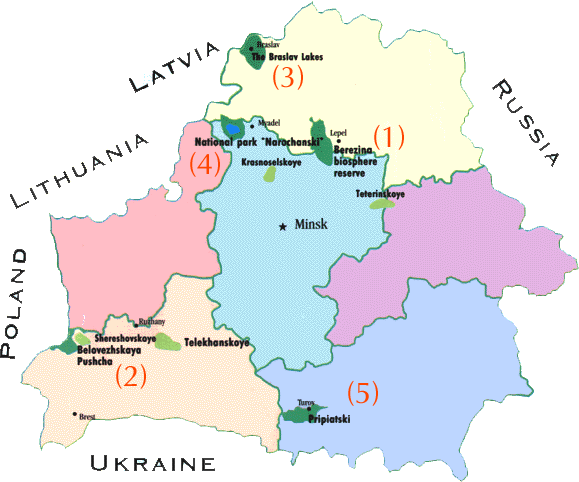
Map of Specially Protected
Natural Territories in Belarus
- Berezinski Biosphere Reserve, located 120 kms north of the Byelorussian capital Minsk.
- Belovezhskaya Pushcha National Park, located 340 kms west of Minsk
- Braslav Lakes National Park, located 250 kms north of Minsk
- Narochanski National Park, located 150 kms north of Minsk
- Pripyatski National Park, located 260 kms south of Minsk
According to the national classification currently 4 National Parks and 1 Biosphere Reserve are recognized in Belarus. They cover a total area of over 400,000 hectares, which makes up about 2 % of the territory of the Republic. The Braslav Lakes National Park and the Narochanski National Park were created in recent years; in 1995 and 1999 respectively. In prior to that these areas served economic and agricultural goals. The other National Parks - Belovezhskaya Pushcha and Pripyatski - have a long history as protected areas and are covered by types of protection other than Specially Protected Natural Territory (SPNT), e.g. as State Reserve and State Protected Game Ground. However, more recently the territories under protection have been enlarged considerably and their functions have been extended.
On January 1, 2001 1 Biosphere Reserve, 4 National Parks, 94 Reserves of nationwide importance, and 458 Reserves of local importance were located in the Republic of Belarus. The total surface of natural territories under legal and primary protection added to 1,579,000 hectares or 7.6 % of the country's surface. These numbers show a tendency of steady, progressive growth. While in 1995 the area of Specially Protected Natural Territories in Belarus covered 794,000 hectares or 3.8 % of the country, in 2000 its surface reached 1,508,000 hectares, cover 7.3 % of the land. On January 1, 2018 in Belarus, 1 285 specially protected natural areas (1 Biosphere Reserve, 4 national parks, more than 370 local reserves with partial protection mode and 880 natural monuments of the national and local importance) are available, with a total area of more than 1.8 million hectares.
Localization and size of Belovezhskaya Pushcha National Park
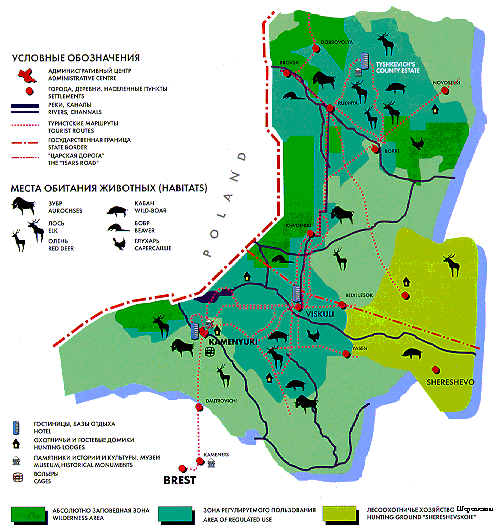
Scheme of Belovezhskaya
Pushcha National Park
Belovezhskaya Pushcha makes up one of the largest lowland forest in the Middle of Europe; the more when the Polish part of the forest is taken into account. The Belarussian part extents an area covered by forests from east to west for 8 to 34 kms, while from the north to the south this distance is 51 kms. In the 1990s, the National Park covered an area of 87,600 hectares of afforested lands (77,800 ha or 88.8 %) and open lands (9,800 ha or 11.2 %). In the 2000s, the surface of Belovezhskaya Pushcha covers an area of over 120,000 hectares. A number of valuable objects with specific ecological values were added to the National Park, amongst which the bog area Dikoe and the Shereshevskoe forestry department etc. At present, the area of the National Park "Belovezhskaya Pushcha" makes up 150,083 ha.
The Administrative Centre of the Belovezhskaya Pushcha National Park is situated in the village of Kamenyuki, at 20 kms north of the District center Kamenetz and 60 km north of the Regional centre of Brest.
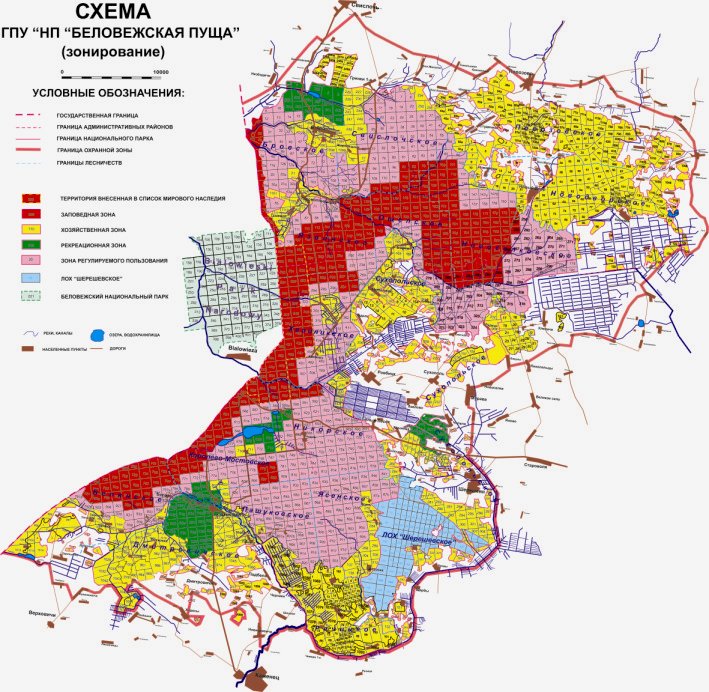
Zoning scheme of Belovezhskaya Pushcha National Park
The territory of Belovezhskaya Pushcha has been divided into 4 functional zones in which the level of protection varies.
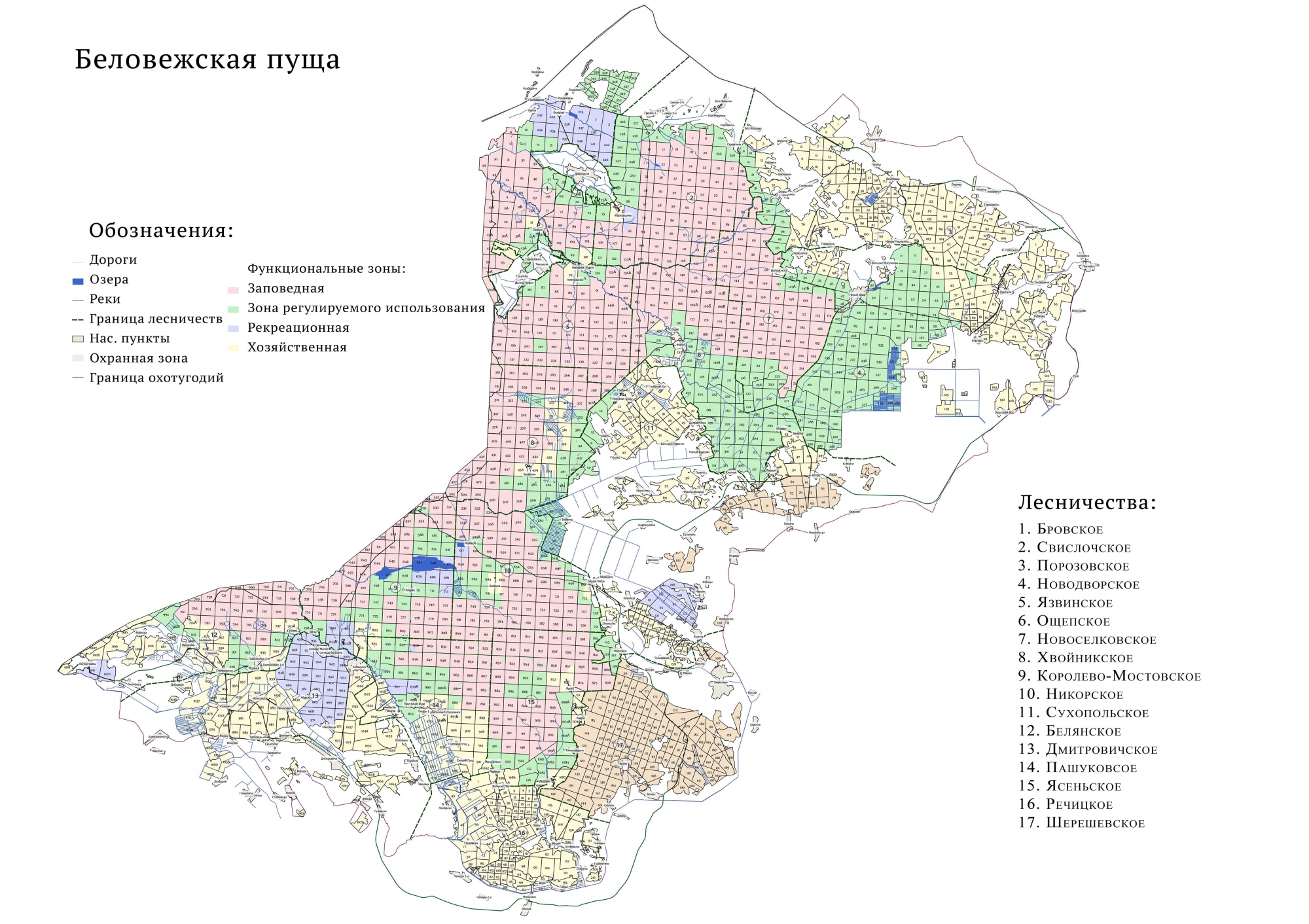
Belovezhskaya Pushcha National Park
Zoning Scheme (2012 year).
(Map taken from the official website
"SNPE "NP "Belovezhskaya Pushcha")
 Wilderness Protection Zone (Core zone) — 58 297 ha or 38.8% (30 000 ha or 18.3% before 2012 year; 15 677 ha or 16.3% before 2004 year)*. This Zone strictly protects all natural areas of intact, wild natural communities. The Wilderness Protection Zone is provided to serve as a reservation of genetic resources (a gene pool) of plants and animals and as a completely natural area. It provides conditions for the natural successions of ecosystems and their components. As such this zone is a reference to full natural circumstances and fully natural growth. The area is managed in such manner as to create conditions which allow the natural development of complexes and their components. This Zone primarily exists of indigenous old-growth coniferous and deciduous forests. Except for scientific research and protection no (commercial, economic or other) activities are allowed for within this Zone.
 Regulated Nature Zone — 37 905 ha or 25.3% (52 780 ha or 32.3% before 2012 year; 65 175 ha or 67.8% before 2004 year). This Zone serves as a site for study, preservation, ensuring the conditions of natural successions and restoration of ecosystems that are characteristic within the Belovezhskaya Pushcha complex, as well as for reproduction and rational use of natural resources, and preservation of historical and cultural monuments and objects. All activities within this Zone should provide optimal conditions for sustainable development of natural communities, while scientifically-orientated nature conservation arrangements are being implemented. Ecotourism is allowed under guidance of guides employed by the National Park.
 Regulated Recreational Use Area — 8 008 ha or 5.3% (6 140 ha or 3.8% before 2012 year; 10 732 ha or 11.1% before 2004 year). The purpose of this area is to encourage tourism and the recreation, to implement activities connected to cultural aspects, leisure and improvement of man’s health as well as to study the impact of recreational pressure upon ecosystems. The Zone includes areas allocated for the placement of tourism facilities, for recreation and health improvement of citizens. Admittance may be free or based on guided visits.
 Economic Activity Zone — 45 872 ha or 30,6% (74 580 ha or 45,6% before 2004 year; 4 614 ha or 4,8% before 2004 year). This Zone has been designated in order to locate administrative, productive and recreational staff and operating facilities, for hosting and serving tourists, for residential purposes, for ensuring the economic functioning of the National Park and the economic activities of the local population. There are no restrictions of access within this Zone.
*The area of each zone (and their cover in percent) as on January 1, 2019.
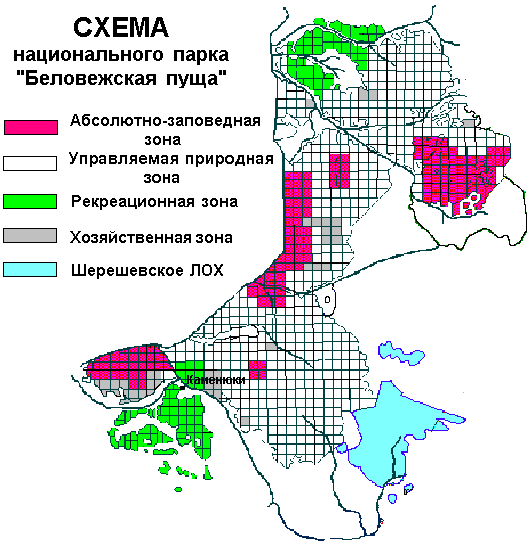
Belovezhskaya Pushcha National Park
Zoning Scheme (before 2004 year)
Belovezhskaya Pushcha National
Park Zoning Scheme
(from 2004 to 2012 years)
In addition, a Support (or Buffer) Zone was established encircling the Pushcha, of some 90,000 ha (before 2004). These lands are in the possession of private and collective users, but a number of limitations on economic activity are imposed. This Zone is designated to mitigate against possible damage caused to nature complexes and sites of the National Park by economic activities on adjacent lands.
A substantial increase in the total area of the National Park by the addition of ecologically valuable and important lands has been the most significant factor in the recent years. Primarily, this has added the hydrological sanctuary Dikoye Bog (a swampy area of European importance of 7.539 ha) and the Shershevskoe Forestry and Game Ground, Pruzhany District (14, 845 ha). The latter area is the base of the Shershevskoye Forestry and Game Ground of a trophy specialization.
Belovezhskaya Pushcha as a transboundary reserve
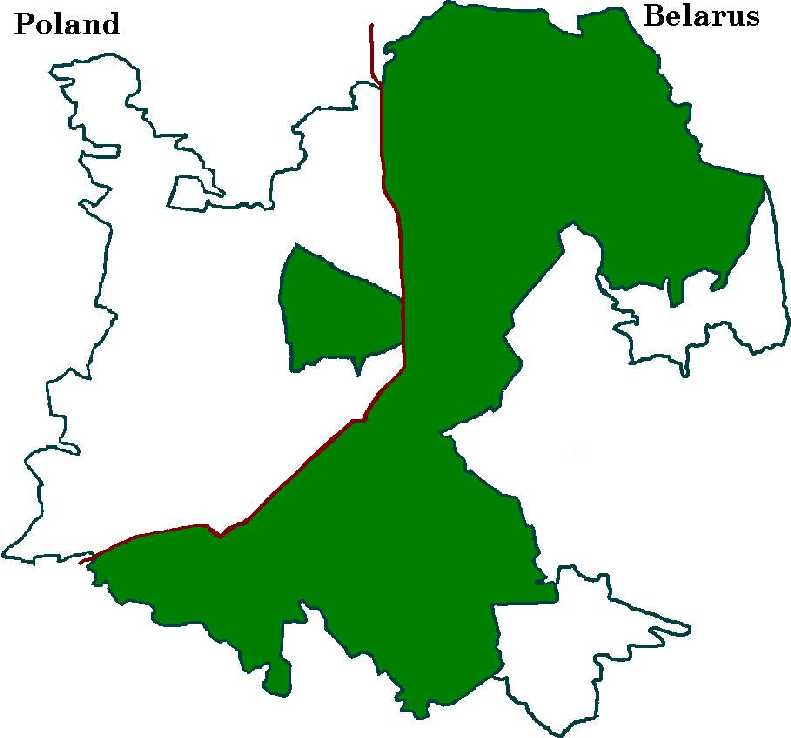
The Belovezhskaya Pushcha is
the transboundary reserve
The Belovezhskaya Pushcha is a transboundary reserve. The forest is situated at the border of the Republic of Poland. This frontier divided Belovezhskaya Pushcha into two parts has been set after World War II; until that time the forest was located entirely within Poland. Nowadays the Belarussian part of Belovezhskaya Pushcha National Park covers over 150,000 hectares.
The Polish part of Belovezhskaya Pushcha (pronounced Puszcza Bialowieska in Polish) equals 62,500 hectares. However, a minor part of the forest is sufficiently protected as a natural territory. Bialowieza National Park covers 10,242.7 hectares of which 6059 hectares are under strict protection.
Since 1992 this strictly protected area of the park and a part of the Belarussian State National Park Belovezhskaya Pushcha, covering 4,500 hectares, have been recognized as a Polish-Belarussian cross-border World Heritage Site. In 2014, the status of a World Natural Heritage Site was extended to the entire territory of the Polish and Belarusian parts of Belovezhskaya Pushcha (Bialowiza Forest).
Since 1994 the forests of Bialowieza other than the National Park have been granted the status of Promotional Forest Complex "Bialowieza Forest". Within forests of this type the Polish State Forestry Department adopts sustainable forest management. It implies that management points at the preservation of natural biodiversity of the forests natural ecosystems. 20 nature reserves, that cover 3,430 hectares, have been erected so far. Two of them are under strict protection; a forest area near Siemianoka and, to a certain extent, Michnowka [data for 2004 year].
Zoning of Bialowieza National Park (Poland) **
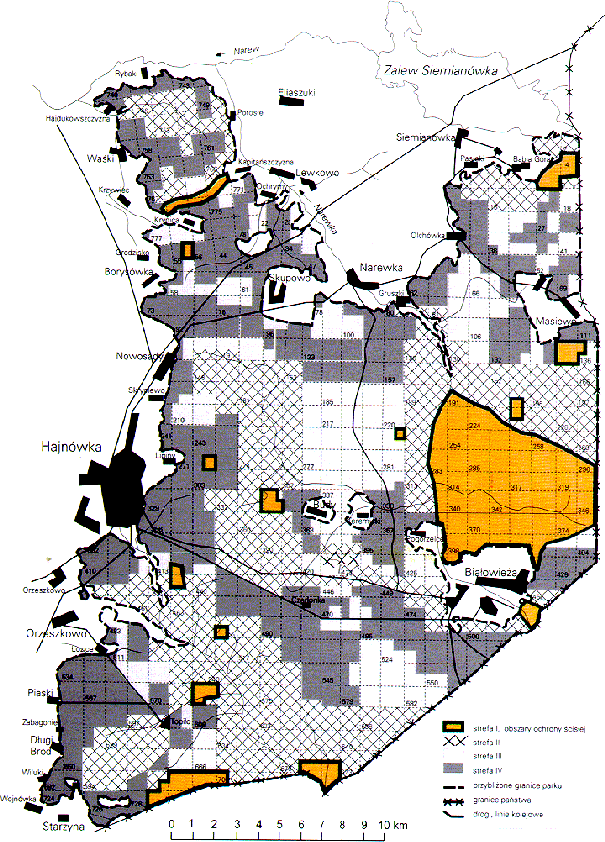
Zoning of Bialowieza National Park
(Poland)
The oldest national Park in Poland started in 1921 and got protected as a natural reserve. It meets all requirements made in criteria for areas protected according to category II (National Park) of the IUCN standards. Bialowieza National Park was granted the status of World Biosphere Reserve in 1977 and World Heritage Site in 1979. A buffer zone of 3,224 hectares surrounds the National Park. This zone exists entirely of forested areas that are under supervision of the superintendence of Bialowieza and Browsk. Other buffer zones have been located around the villages of Bialowieza, Pogorzelce and Masiewo. Potential threats could reach the National Park from these places.
Since 1992, the strict protection zone (core zone) together with the adjacent territory of the Wilderness Protection Zone of the Belarusian National Park "Belovezhskaya Pushcha" forms a cross-border Polish-Belarusian World Heritage Site. In 1997, Bialowieza National Park has been distinguished with the honorable European Diploma for the outstanding management of its "vegetation", which is of primeval origin.
Since 1994 the forests of Bialowieza other than the National Park have been granted the status of Promotional Forest Complex "Bialowieza Forest". The objectives of this Complex are to maintain an ecological- friendly forestry and the conservation of biological diversity. In its area there are 20 nature reserves (3,429.65 hectares), but only 2 of them are covered by strict protection (Siemianoka and partially Michnowka). About 1,200 trees within Bialowieza Forest are protected as nature monuments.
**The size and territorial distribution of separate zones of the Polish part of Bialowieza Forest is given according to data as of October 1, 2004.
Latest description of the Polish part of Bialowieza Forest (in Polish and English) on the website of the Bialowieza National Park (Bialowieski Park Narodowy).
More about Belovezhskaya Pushcha =>
[History] [Geographical location and general information] [Climate, hydrology, geology and geomorphology] [Soils] [Flora and vegetation] [Fauna] [National Park's structure] [Protection] [Science and research] [Cultural monuments and tourism] [Belarusian Grandfather Frost's Residence] [Economic activity] [Maps and schemes] [Addresses and contacts]